The Competitive Edge: How to Build a "High-Performance" Mind for Exams
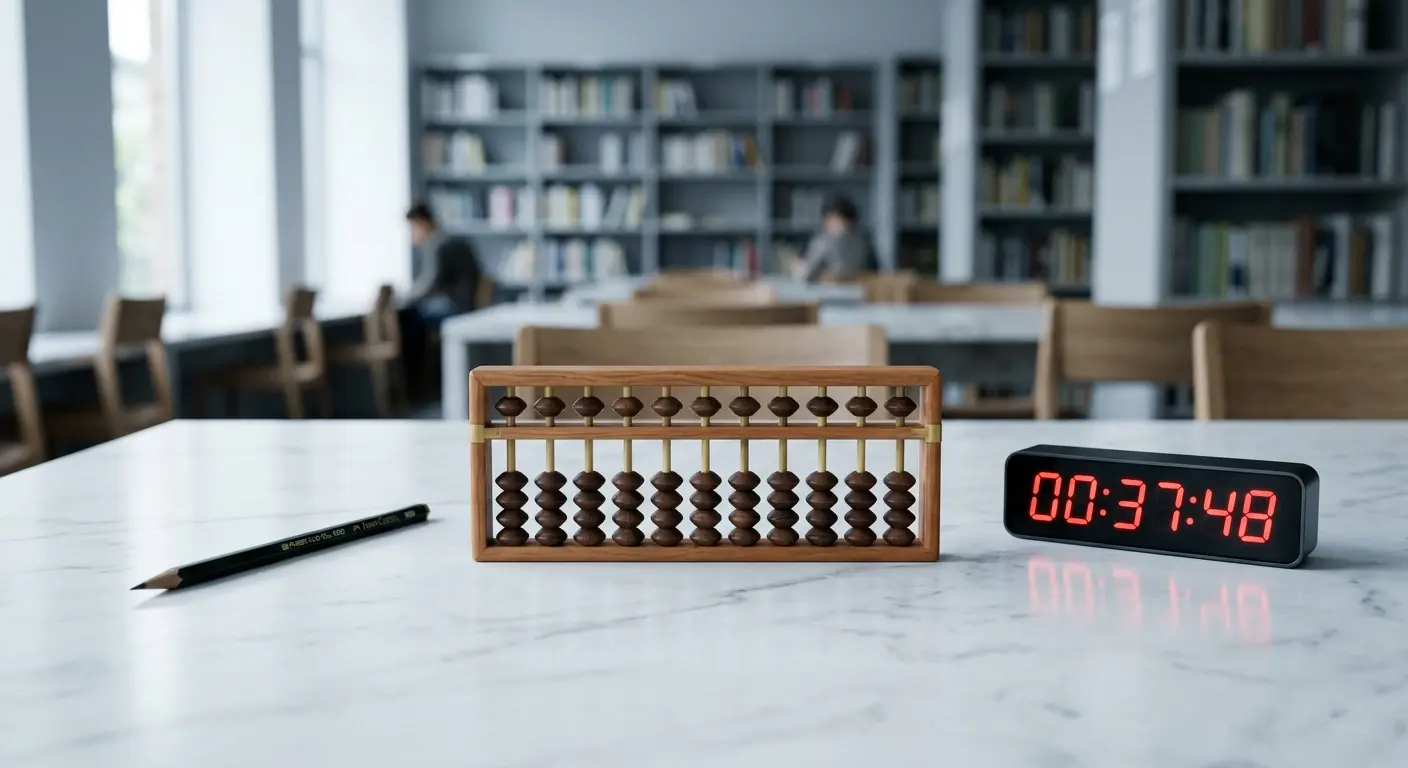
Most students approach competitive exams with the wrong mental model. They believe that if they study more hours, they will get better results. But in the high-pressure environment of a National Level exam, "knowing" the answer isn't enough. You have to find the answer faster than the student sitting next to you.
Competitive exams are a race against the clock. When you have 60 seconds to solve a complex problem, your brain cannot afford to "think" in the traditional sense. It must execute. To win, you must move your mathematical processing from your conscious mind to your subconscious mind.
The "System 1" Advantage
Psychologist Daniel Kahneman famously described two systems of thought: System 1 (fast, instinctive, and emotional) and System 2 (slower, more deliberative, and logical). Most students solve math using System 2—it’s taxing, slow, and prone to fatigue.
Abacus and Mental Math training is the process of migrating arithmetic into System 1. When a My Abacus Pro student sees a string of numbers, they don't "calculate" them; they "see" the beads move instinctively. This leaves their System 2 brain entirely free to handle the complex logic of the exam's word problems.
The "Champion’s Blueprint" for Preparation
Success in competitive exams is built on three pillars: Accuracy, Speed, and Stamina. If you lack even one, the structure collapses. Use this comparison to evaluate your child's current preparation strategy:
| Pillar | Traditional Study | The Abacus Edge |
|---|---|---|
| Accuracy | Double-checking work (Time-consuming). | Intuitive "Number Sense" (Instant). |
| Speed | Writing out steps on paper. | Mental visualization (High-speed). |
| Stamina | Mental fatigue after 45 minutes. | Trained focus via 15-min "Anzan" sprints. |
1. Eliminating "Calculation Fatigue"
In a 3-hour competitive exam, the biggest enemy is not the difficulty of the questions—it is fatigue. Every time a student has to manually multiply or divide, they burn a small amount of "cognitive fuel." By the third hour, their brain is exhausted.
Because Abacus students have automated their basic arithmetic, they preserve their mental energy. They arrive at the final, most difficult questions of the exam with a fresh, sharp mind, while their peers are struggling with "brain fog."
2. The "Buffer" Technique
Competitive exams often include "distractor" information. Students who calculate slowly often lose their place in a problem when they get distracted. Mental math builds a larger "Working Memory Buffer." By holding the intermediate steps of a problem as a visual image (the mental abacus), students can navigate multi-step problems without losing their way.
3. The 1% Rule of Daily Drills
You don't win a National Competition in a single day of intense study. You win it by being 1% better every morning. At My Abacus Pro, we advocate for the "Zero-Day" Policy: never go a day without at least 5 minutes of high-speed Anzan practice. This keeps the "neural pathways" for math greased and ready for action.
Ready to Outpace the Competition?
Don't let slow calculations hold your child back from their true potential. Give them the cognitive hardware required for competitive success.
Put these techniques into practice
Want to build the lightning-fast calculation skills mentioned in this article? Our specialized practice tools allow you to drill these specific formulas.
Used by 1,000+ students worldwide to master Soroban techniques.
Written By
Satish Mane (Abacus Trainer)