Beyond the Beads: A Complete Guide to the World’s Most Powerful Mental Tool
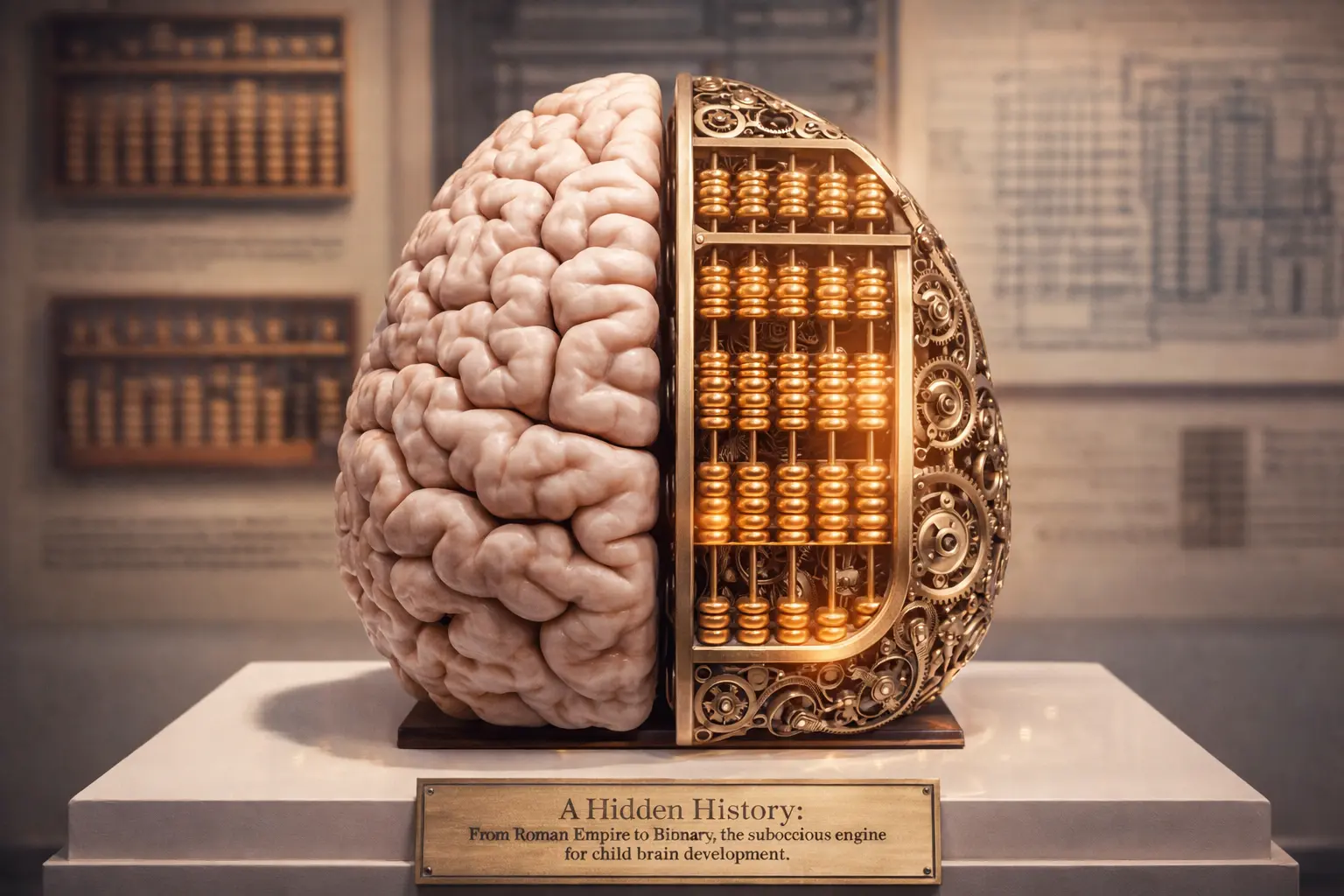
Most people view the abacus as a simple wooden toy—a relic of a pre-digital past. But to the trained eye, the abacus is something far more profound. It is a physical manifestation of mathematical logic, a tool that has guided bankers in Rome, merchants in China, and engineers in Japan for over two thousand years.
While electronic calculators have replaced the need for manual arithmetic, they have also created a "black box" in education. A child pushes a button and a result appears, but the logic remains hidden. The abacus does the opposite: it makes math visible, tactile, and undeniable. In this guide, we explore the global evolution of this tool and why it remains the ultimate "brain-hack" for the modern student.
A Global Evolution: One Tool, Many Faces
The beauty of the abacus lies in its adaptability. Almost every major civilization developed its own version, proving that the human need for visual calculation is universal.
The Suanpan (Chinese Abacus): Dating back to the 2nd century BC, the Suanpan features a 2/5 bead configuration. This design was revolutionary because it allowed for not just decimal math, but hexadecimal computations as well. Masters of the Suanpan were known to calculate square roots and cube roots with a speed that rivaled modern machines.
The Soroban (Japanese Abacus): Developed in the 14th century, the Soroban refined the Chinese design into a sleek 1/4 bead system. This version is the primary tool used in 2026 for high-speed mental arithmetic (Anzan). Its minimalist design is perfect for building a fast, accurate mental image in a child's mind.
The Roman Hand Abacus: Even the architects of the Colosseum relied on the abacus. Using metal plates and sliding stones, Roman engineers and money changers used this tool to manage the complex logistics of an empire. It was a portable, indestructible computer for the ancient world.
The "Binary" Connection
One of the most fascinating versions is the Binary Abacus. It demonstrates that the logic of the abacus is the same logic that powers your smartphone. By using beads to represent "1" and "0" (on and off), students can visualize how computers convert complex data into simple electrical pulses. It is the perfect bridge between ancient wisdom and modern coding.
More Than Math: The Cognitive "Side Effects"
If you ask a parent at My Abacus Pro why their child practices daily, they won't just say "to get better at addition." They will talk about the life skills that the beads cultivate. Here are the four primary "hidden" benefits:
- Tactile Cognitive Mapping: For children with visual impairments or learning differences like Dyscalculia, the abacus provides a tactile method to "feel" numbers. It turns abstract symbols into physical reality.
- Erasure of Math Anxiety: Fear of math usually comes from a lack of control. Because the abacus is a game of physical movement, the "fear" is replaced by "action." When you can move a bead to solve a problem, the problem no longer feels scary.
- Precision in Handwriting: The micro-movements required to slide a single bead without disturbing others develop fine motor skills. We often see a direct correlation between abacus mastery and neater, faster handwriting in school.
- The Visualization Shield: In a world full of digital distractions, the ability to close your eyes and "see" a mental abacus is a form of meditation. It builds a mental shield that allows children to tune out noise and focus on deep work.
The Foundation of the "Master Mind"
The best time to introduce the abacus is during the "formative window" of ages 6 to 12. At this stage, the brain is like wet cement—it takes an impression easily but will soon set permanently. By introducing the abacus during this period, you aren't just teaching a child to count; you are teaching their brain how to organize information.
Think of it as installing a high-speed processor in an old computer. The math is just the software; the abacus is the hardware upgrade.
Empower Your Child's Journey
Don't just teach your child to solve problems—teach them to see them. Join My Abacus Pro and give your child the ancient tool that builds a modern future.
Book a Free Level Assessment →Put these techniques into practice
Want to build the lightning-fast calculation skills mentioned in this article? Our specialized practice tools allow you to drill these specific formulas.
Used by 1,000+ students worldwide to master Soroban techniques.
Written By
Satish Mane (Abacus Trainer)
More in Education
Continue your learning journey with these related articles.
7 Surprising Ways Abacus Training Boosts Your Child's IQ and Focus (Science-Backed)
Discover the scientific link between abacus training and cognitive development. Learn how Soroban mastery enhances memory, focus, and overall IQ.
The Future of Abacus (Soroban): Why This Ancient Tool is the Ultimate 2026 Tech Skill
In an era of AI and automation, why is the Japanese abacus more relevant than ever? Discover how Soroban training prepares the next generation for a world that demands high-speed cognitive processing.